
Intel Unveils New AI GPU With 480GB of Memory

What Makes Intel Crescent Island Special
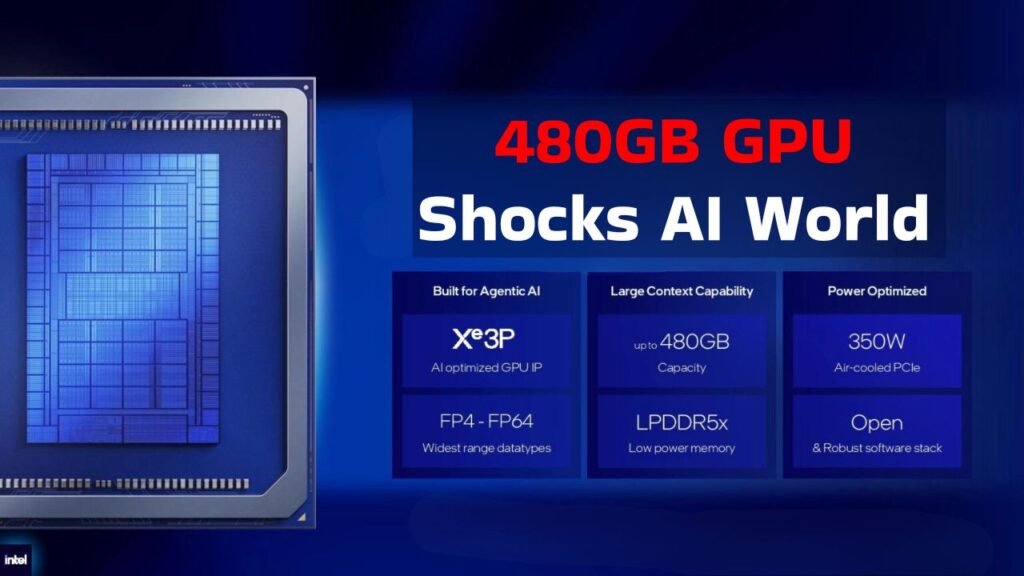
Intel’s Crescent Island is unique because it addresses the biggest pain point in AI servers: memory. Many AI models are growing faster than the hardware memory capacity, so developers often split workloads across many cards. A GPU with up to 480GB of LPDDR5X memory enables more model data to be stored near the processor. This can reduce the movement between devices and may make the inference for large models smoother . But Intel isn’t just after top benchmark numbers here. “We are trying to deliver a practical accelerator that is compatible with standard PCIe server designs and supports a wide range of data formats.” For businesses this means faster deployment, larger workloads, more flexible AI infrastructure without the need to completely rebuild the data centre from scratch.
 LG Monitor Software Installation Through Windows Update Makes Driver Setup Easier Than Ever
- It is intended for AI inference and enterprise workloads.
- The biggest highlight is support for up to 480 GB memory.
- It’s based on Intel’s Xe3P architecture.
- Compatible with standard PCIe server systems
- The company offers an alternative to Nvidia and AMD for businesses.
Why 480GB Memory Matters
Memory option of 480GB is important as AI inference is becoming more memory hungry year on year. If such a model is too large for a single GPU, it needs to be partitioned among multiple accelerators which can be more expensive, slower and complicated. More memory per card means larger models, larger batches and longer context windows can fit on a single server. Intel’s shift to LPDDR5X is also important in that it can provide high capacity with greater efficiency and less pressure on the limited supply of HBM. While this approach may not always win out against HBM on bandwidth, it can deliver a powerful combination of capacity, power, availability and cost for many enterprise AI workloads today that value memory size more than absolute bandwidth alone.
 Apple iPhone 18 Pro Release Date Leak Reveals New Details Alongside Latest EU AirPods Rule Changes
- Bigger AI models need big memory.
- It can help to alleviate the need to split models across multiple GPUs.
- LPDDR5X can help you to save cost and power.
- It allows for larger AI context windows.
- This is helpful for memory intensive inference workloads.
Who Can Use This AI GPU
The GPU is primarily for data centres, cloud providers, research labs and companies building AI services. This is not a gaming card for the average desktop user. Crescent Island is designed for inference, or quickly answering questions with trained AI models. This is useful for chatbots, coding assistants, search tools, document analysis, healthcare systems, financial models and internal business agents. More memory will allow teams to serve larger models to more users, with fewer trade-offs. The card is PCIe-based, so companies might be able to squeeze it into existing 4U or 5U servers. This makes the platform more usable for organisations that want the power of AI but don’t want to go to the extreme of custom hardware or expensive major facility redesigns.
 New Smart Ring With Cuffless Blood Pressure Monitoring Could Change Personal Health Tracking
- Cloud companies can use it for AI services.
- Labs are able to run large AI models.
- Companies can have their own AI helpers.
- It’s good for workloads that are inference-focused.
- It’s not a gaming PC, not really.
Market Impact and Competition
Nvidia and AMD currently dominate the accelerator market but Intel’s new AI GPU could even the playing field. The big message is not performance, but choice. If Intel can offer good software support, stable drivers and good pricing Crescent Island may find buyers that need memory rich inference cards. Developers who care about open tools and support for a range of workloads may also find the oneAPI software stack attractive. But success will be driven by real world benchmarks, availability, partner designs and how easy it is for companies to port existing AI models to Intel hardware. 480GB? Impressive. But customers will want to see shipping products, tested performance and clear total cost before they make decisions for serious data centre purchases at scale globally.
Final Verdict
Intel’s Crescent Island shows where AI hardware is headed: bigger, smarter and memory-centric. Its 480GB LPDDR5X memory could be useful for inference workloads where model size, context length, and server efficiency are important. “The GPU is not for gamers, it’s for enterprise AI, cloud systems and data centres. This GPU could be a serious contender for companies that want powerful AI acceleration with easier server integration and memory flexibility in future AI deployments, if Intel can deliver solid software, good pricing, and reliable availability.
