
Tesla Under Federal Investigation After Fatal Model 3 Crash in Texas

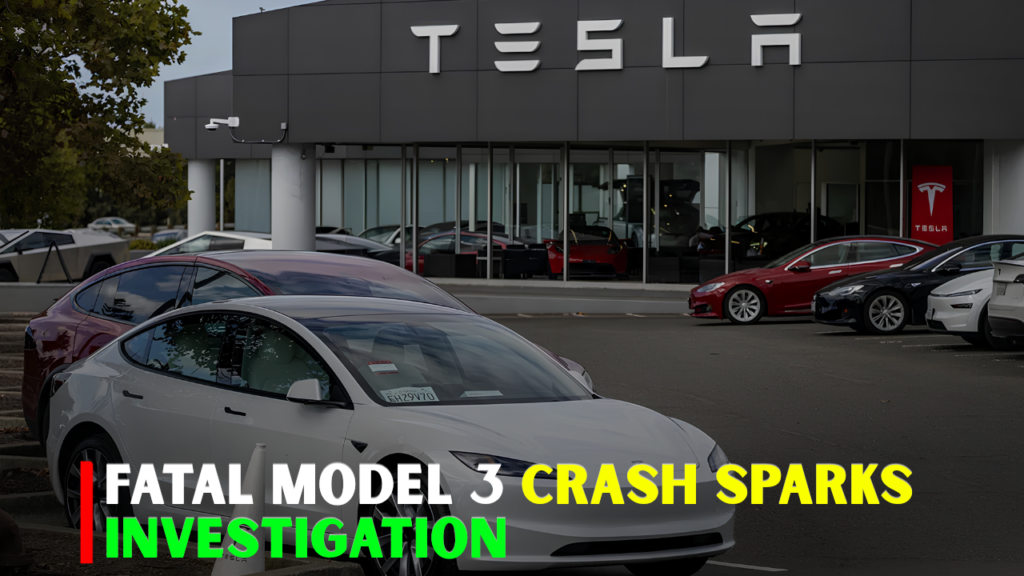
Tesla Under Federal Investigation : Federal regulators are keen to know what happened in Texas, where a Tesla Model 3 crashed into a house in Katy and killed a woman inside. The incident has reignited public concerns about Tesla’s driver-assist technology and what automated systems can and cannot do on residential roads. Authorities are now working to reconstruct what happened in the minutes before the vehicle left the road and struck the home at a high speed.
NHTSA investigations
The National Highway Traffic Safety Administration has opened a Special Crash Investigation into the June 19 crash. These investigations are only performed in the case of a serious or unexpected incident, especially with the use of modern car technology. Investigators will look at vehicle data, the driver’s behaviour, road conditions and if a Tesla driver-assistance system was involved in the crash. The examination does not imply a defect has been found, but it places the event under close federal inspection.

What happened in Katy
The crash happened at about 8 p.m. in Katy, a city west of Houston, Texas. Michael Butler, of the local authorities, was driving a Tesla Model 3 when it lost control, veered off the road and collided with a brick house. A car sped into the house and hit Martha Avila, 76, who was inside at the time.

Avila was taken by medical helicopter to a hospital but died of her injuries. Butler was also injured in the crash. Investigators stated he showed no signs of intoxication and cooperated with police. The latest reports claimed the local probe is still going on and no charges had been announced.

Conflicting Reports Surface
An important question is whether the Tesla’s autonomous driving-assistance technology was engaged at the time of the crash. The motorist told the Harris County Sheriff’s Office they were using an automated assistant feature at the time. The comment immediately raised eyebrows, as regulators, safety experts and crash investigators have been scrutinising Tesla’s Autopilot and Full Self-Driving systems for years.
But Ashok Elluswamy, Tesla’s director of self-driving, has a different story to tell. “He’s hand-flown the system by pushing the accelerator all the way forward,” he claimed. He said the car was driving at 73 mph when it crashed and pressure on the pedal maintained after collision.
The contradictory versions make the investigation all the more vital. Federal investigators will probably look at logs from the automobile to determine whether Autopilot, Full Self-Driving or some other driver-assistance mode was on. They will also examine speed, steering input, braking, acceleration and driving behaviour before the collision.
There is scrutiny of Tesla’s driver-assist systems.
Tesla’s driver-assist systems are not designed to turn the car into a fully driverless vehicle. The organisation also says drivers need to stay alert, keep both hands near the wheel and be ready to take control at all times. But the words Autopilot and Full Self-Driving have also sparked doubts about whether drivers are over-relying on the system.
The Texas tragedy came as Tesla is already under broad federal enquiry for its automatic driving technology. The NHTSA has been investigating a string of Tesla crashes since 2016 where the driver-assist functions are believed to have been active. The government also considered reservations about the systems’ ability to monitor driver attention and react to difficult driving scenarios.
Tesla has recalled almost 2 million cars in the U.S. in 2023 to enhance the safety features of Autopilot. The recall was meant to strengthen warnings, and make drivers aware. That said, officials have been looking at whether the measures are enough.
Why This Matters
The surprising thing is that this happened in a residential location and killed a person in a house, not another road user. This has raised worry about the effect of high-speed vehicle failures or driving errors on persons far from the route.
The investigators said the question is not just whether a Tesla function was engaged but also how the driver and the car performed. Investigators will have to determine if the driver’s foot was on the pedal long enough to cause the crash. They also need to know if an automatic system was engaged and if it was properly deactivated, if it warned the driver or if it responded in the manner it was supposed to, he said.
The results could help inform future regulation of driver-assistance technology. They can also influence public perceptions of what these systems can and cannot do.
The investigation continues
The Katy fatal crash is now part of a wider national discussion on automation, driver responsibility and vehicle safety. Tesla has made its name on the edge of technology, but every fatal incident puts more pressure on regulators to examine how that equipment works in the real world.
For Martha Avila’s family, the investigation is about getting answers and holding someone responsible. Another measure for federal safety inspectors is whether current rules are keeping up with fast-moving car technology. The crash remains under investigation with the cause not yet known, but the incident has once again brought Tesla’s driver-assistance systems into focus.
