
Caltech Begins Work on Powerful New Radio Telescope

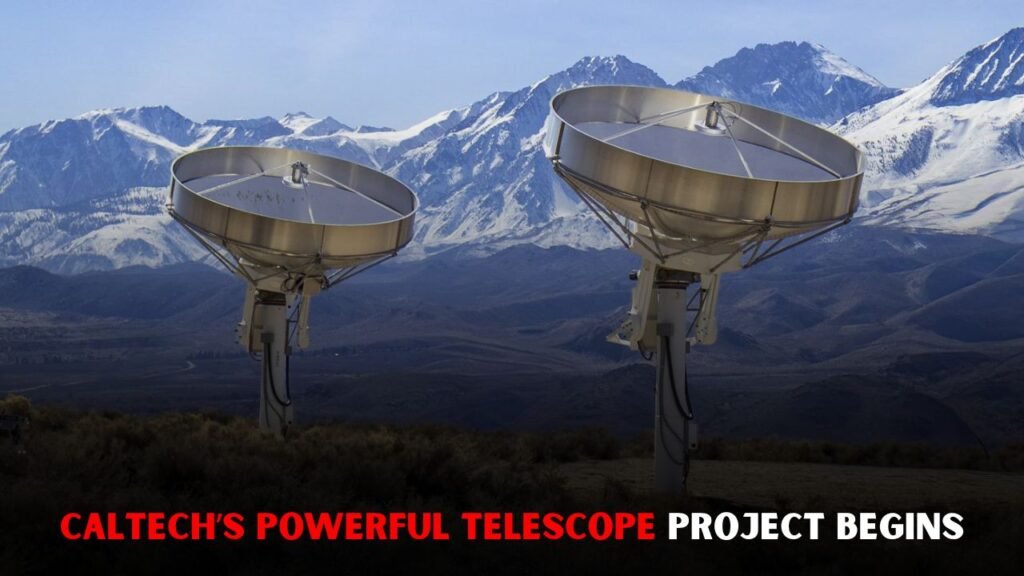
Caltech is leading one of the most powerful telescope projects in modern astronomy. The new radio telescope, called the Deep Synoptic Array, or DSA, will study the universe in radio waves. Black holes, dead stars, fast radio bursts, galaxies and a host of other objects in space cause these waves. The project is led by Caltech with support from Schmidt Sciences. It will be built in a remote Nevada valley where there is less radio noise and the sky can be observed more precisely. The DSA will consist of 1,650 radio dishes just over 6 metres in diameter. Caltech hopes to complete the telescope by 2029 and begin doing science shortly thereafter. When finished, it could be the most sensitive radio telescope ever built and help scientists produce a more detailed, faster and clearer map of the radio universe.

What is unique about Caltech’s new radio telescope?
The Deep Synoptic Array is special in that it combines two major strengths into one telescope system. The large single dishes are very sensitive and groups of many dishes produce even sharper images. The DSA is built to do both. It will pick up faint radio signals from deep space and translate them into high-resolution images. It will form one giant scientific eye with its 1,650 dishes That will allow astronomers to look at objects that are too faint, too far away, or too fast for older systems. The telescope will also be able to scan the sky much faster than current radio telescopes. That speed will enable scientists to find new stars, galaxies, black holes, pulsars and strange fast radio bursts.

- It will be a collection of 1,650 radio dishes working in concert.
- It will be built in a remote, quiet valley in Nevada.
- It is meant to produce very sharp radio images .
- It will be able to detect the faintest signal from deep space.”
- It can scan the sky 100 times faster than other radio telescopes.
Deep Synoptic Array: Mapping the Universe
The DSA will be a cosmic eavesdropper, picking up radio signals from all manner of objects in space. Radio waves can travel a long way and bring us news of violent happenings out in space. These are jets from black holes, exploding stars, rotating neutron stars and fast radio bursts. The telescope will repeatedly survey large portions of the sky, helping scientists better catch changes over time. This is important because many space events are transient, sudden, or rare. It will also teach scientists about how galaxies are formed, how dark matter may be shaping the universe and how the universe is expanding. Its large field of view and fast survey will be useful for planned studies as well as serendipitous discoveries.

- It will pick up radio waves from distant galaxies.
- Fast radio bursts and their host galaxies are useful to study.
- It will track things in sky.
- It will be a good study for black holes and pulsars.
- We might get a glimpse of the universe’s structure.
Real Time Radio Camera Technology
The DSA has a very important feature and that is the radio camera in real-time. It can be slow to turn raw data into images from conventional radio telescopes. The aim of the DSA is to generate images from radio signals in near-real time. This is important, because the telescope will create a huge amount of data from its 1,650 dishes. All the raw data would be very expensive and difficult to store. The radio camera, instead, will rapidly analyse the data and store useful images. In the near future, such images will probably be available to the scientific community. This technology will make radio astronomy faster, more open and more useful to the global research.

- It will generate radio images in real time.
- This will reduce the need to store large quantities of raw data.
- It will process it fast with the use of high performance computing systems.
- It will provide scientists with data.
- This will help to catch short and sudden space events in a rapid way.
Why This Telescope Matters for the Future of Astronomy
Why the new Caltech radio telescope is important The new Caltech radio telescope lets scientists change how they explore the radio sky. The largest objects in space are invisible to the naked eye, but can be seen in radio waves. The DSA will allow astronomers to find millions of new radio sources and learn about energetic cosmic phenomena in detail. It could find new fast radio bursts, new pulsars and radio signals from distant galaxies. It will also benefit gravitational wave astronomy, allowing for more precise localisation of events such as neutron star mergers. The data will be rapidly released for use in novel research by researchers around the world. The project could make radio astronomy more alive, more connected, faster.
Final Verdict
The Deep Synoptic Array at Caltech is a huge leap forward for the future of space science. Scientists now have 1,650 radio dishes to see the radio universe in a new way, with fast survey power and real-time radio camera technology. The telescope is expected to find many new cosmic objects and help us learn more about black holes, pulsars, fast radio bursts, galaxies and the expansion of the universe. Used as intended, the DSA may be one of the most useful tools in astronomy today.
