
Apple Reveals Why Siri Upgrade Took Longer Than Expected

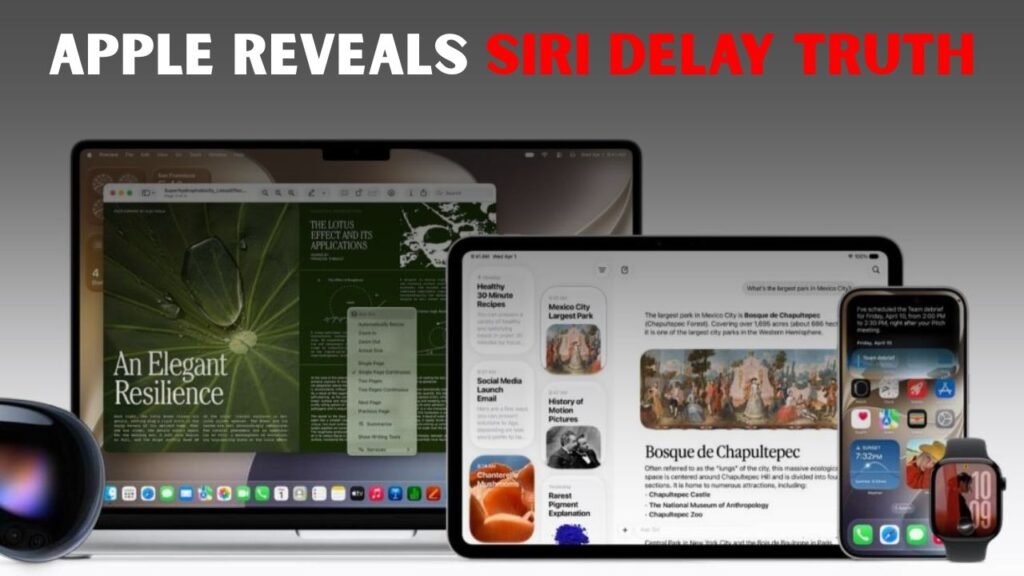
Apple has at last explained why the long-awaited Siri upgrade took longer than many users expected. The company didn’t want to release an assistant that was smarter, looked good on demos but didn’t work in the real world. Apple’s leaders said the new Siri needs to better understand people, control apps and be more reliable before it can be released to users. Earlier plans featured Apple Intelligence, but the features proved harder to complete to Apple’s quality level. Upgrade must be able to grasp user context, work across apps, keep private data protected, and reply naturally without making many mistakes. Siri is built into iPhone, iPad, Mac and other everyday devices, so even small errors can sour the experience. Apple chose a delay over a weak launch. The message is clear: Apple wants Siri to feel useful, safe, private and dependable, not just another rushed AI feature for the millions of people who use it every day.

Why Apple Held Off on Siri’s Upgrade
The delay was for a simple reason: Apple didn’t think the new and improved Siri was reliable enough. The company had promised a more personal assistant, one that could understand what’s on the screen, remember useful context and take action inside apps. But creating this kind of assistant is a whole lot harder than slapping a chatbot window on it. Siri needs to be able to work with messages, calendar events, photos, files, contacts and device settings. If it misinterprets a request, it may return incorrect information or take incorrect action. So Apple decided trust was more important than speed. Rather than release an incomplete tool, it kept testing, rebuilding and improving the system until the experience was up to normal Apple standards on every device today.

- Apple wanted Siri to work in the real world.
- “The first one just wasn’t ready for the public release.”
- Siri had to get better at understanding personal context.
- App control had to be more accurate and safer.
- Apple would rather wait than launch weakly.
What the new Siri will do
The new version of Siri is being said to be more useful because it is designed to comprehend personal context and not just simple voice commands. Older Siri could set alarms, answer basic questions, and change some settings, but the new version is meant to link information from apps in a smarter way. For example, it might pick out a detail from a message, draw on data from an email, or complete a task in another app. That calls for good app integration and tight permission control. Apple wants Siri to be helpful without feeling weird or dangerous. That’s why the delay matters. The goal is not only better answers, but a smoother assistant that can actually do helpful tasks in real moments on demand every day smoothly.

- Siri may be able to tell what’s on the screen.
- It could tap into personal context from Apple apps.
- It can do things inside apps that it knows how to do.
- It should respond more naturally.
- It will be more useful for the daily work.
Apple’s Quality and Privacy Problem
Apple’s challenge is different from many AI companies since Siri is built into private devices and daily workflows. A regular chatbot might give a wrong answer and the user can just ignore it. But Siri can control apps, read the user’s personal info, and act on the user’s device. That makes accuracy & privacy a whole lot more important. And Apple’s push for on-device intelligence and secure cloud processing means it can’t scoop up user data the way some online AI services do. This privacy-first design is a strength, but also a drag on development. Before the upgrade could feel ready for everyday users at scale worldwide safely too, Apple had to balance smart answers, fast performance, safe data handling, and dependable actions.

- Siri has to protect the user data, especially the private data.
- It should avoid wrong actions inside apps.
- Apple has to balance AI power against privacy.
- It can be harder to develop when the processing takes place on the device.
- Quality testing is very important for the trust of the user.
What iPhone users need to know
For iPhone users, the delay is both disappointing and practical. The longer wait drew criticism as many people had expected Apple Intelligence to be followed by the smarter Siri. But a late but steady helper is better than an early tool that fails often. Users want to save time, use natural language, and get things done without repeating corrections. If Apple pulls this off, Siri could become a more useful, everyday assistant for planning, searching, writing and managing apps. Otherwise, users may continue to prefer competing AI tools. The delay is a sign that Apple knows expectations are high, and that the company has to prove Siri can finally compete in the modern AI era with real confidence and clear practical value ahead soon.
Final Word
Apple took longer to upgrade Siri because the company wanted to get it right before it went public — reliable, private and really useful. The lag points to the difficulty of powerful AI that can understand personal data and safely take control of apps. It can frustrate users but Apple’s choice is to protect trust. Don’t rush Siri. It can do more harm than good. Apple’s upgrade may be powerful enough to finally make Siri a more intelligent assistant for day-to-day tasks. The real test will be if it works smoothly, privately and consistently for normal users in daily life everywhere now.
