
US Bond Yield Rises to 2007 High on Inflation Worries

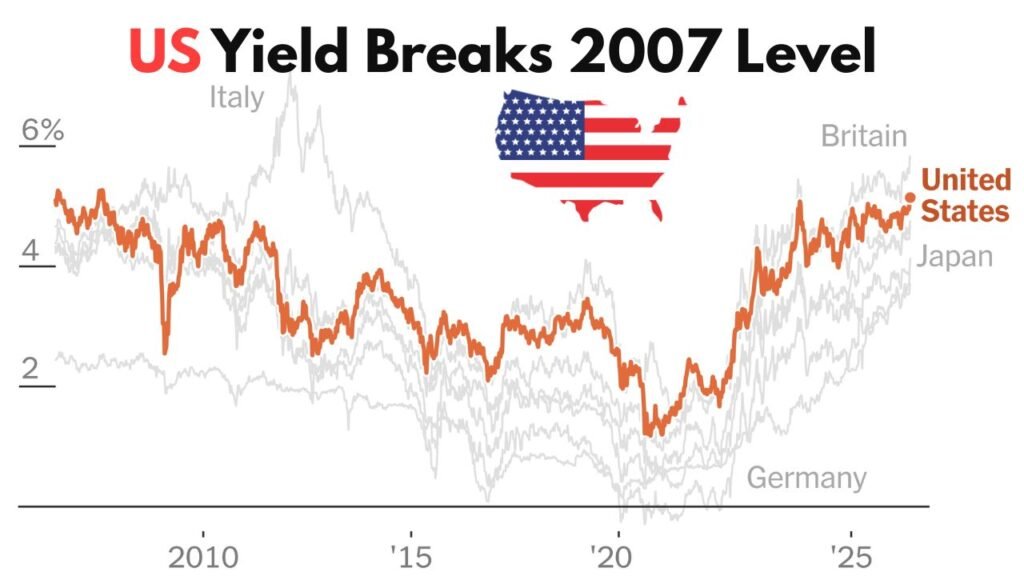
US Bond Yield Rises to 2007 High : Once again, the world’s financial markets are facing stress, this time due to the rise in US bond yields to their highest level since 2007, primarily due to the resurgence of inflation concerns. The bond market is receiving close scrutiny from investors since an increase in yields can be considered as a sign of changes in interest rates and inflation expectations and stability. Due to the return of inflation concerns, yields have risen sharply, creating stress in the equity markets and raising borrowing costs in various sectors. This situation highlights the uncertainties regarding the period for which inflation will continue at a high level and the possible measures that the Federal Reserve will take.

US Bond Yield Rises to 2007 High on Inflation Worries
In the case of US Bond Yield Rises to 2007 High on Inflation Concerns, there is a marked change in the investor mood because inflation continues to be persistently high. It must be noted that long-term bond yields have risen due to concerns about sustained high-interest rates. In addition, the Fed’s determination to tackle inflation has added to the problem since it means that interest rates will stay higher for longer than anticipated. All this has made investors less willing to invest in bonds at prevailing yields. There are also economic uncertainties around the world, as well as energy price changes, that are affecting the stability of the market.

| Key Factor | Details |
|---|---|
| US Bond Yield Level | Highest since 2007, driven by inflation concerns |
| Main Trigger | Persistent inflation and interest rate expectations |
| Federal Reserve Policy | Signals higher rates for longer duration |
| Market Impact | Pressure on equities and higher borrowing costs |
| Investor Sentiment | Cautious, risk-averse behavior increasing |
Inflation Pressures Driving Treasury Market Volatility
The problem of inflation remains the main driving factor behind movements in the US Treasury market. Inflation continues to rise, thus compelling investors to revise the value of their long-term bonds because real returns have become challenging to achieve. Such factors as rising energy prices, housing prices, and wages continue to fuel the problem of inflation persistence. It is becoming increasingly hard to ignore that investors are looking for higher interest rates to offset the erosion of their purchasing power due to higher inflation. In such an environment, it has become very volatile for bond investors because they are highly sensitive to price changes. It has become increasingly difficult to forecast inflation trends, which is why portfolio managers are lowering duration risk.

Federal Reserve Policy and Interest Rate Expectations
Monetary policy of the Federal Reserve continues to be one of the main factors driving the increase in bond yield in the US. Investors are convinced that interest rates will be high for an extended period since policymakers are determined to bring down inflation. Consequently, the demand for long-term bonds has fallen, leading to the increase in yields. Policymakers have stated that their priority is to lower inflation to the target level regardless of whether this will slow down economic growth in the short term.

Impact on Equity Markets and Investor Behavior
Bond yields are rising and this has an immediate impact on stock markets usually resulting in increased market volatility and a decreased appetite for risk by investors. The higher the yield the more attractive the fixed income security becomes relative to the stock market especially those in growth industries such as technology. The shift in the allocation of capital may result in downward pressure on equity prices. Investors are positioning their portfolios in favour of short term bond and defensive stocks. In addition to these higher yields mean higher discount rates for stock valuation and hence lower earnings expectations in the future. This poses problems for equities that rely on earnings expectations. Investors are being picky focusing on stocks with positive cash flow and stable earnings.
Sources : NYTimes.com
Global Economic Outlook and Market Uncertainty
High yields in the US tend to encourage capital inflows from emerging markets, which put strains on the foreign currencies and economies. This could result in tighter liquidity in the global economy and increased volatility in the international markets. Countries that have a high level of external debts become especially susceptible as rising interest rates in the US will make it difficult for them to refinance their debts. Moreover, growth in international trade continues to be uneven. Investors are monitoring the reaction of various central banks to the US monetary policy changes.
US Bond Yield Rises to 2007 High on Market Shift
With inflation expected to exhibit persistence, the yields might continue to be at high levels or could even move higher. Nevertheless, any indication of reduced price pressure could have a stabilizing effect on the market and give some relief to investors. The interplay between the growth and inflation issues will determine how the market evolves in the coming period. It is believed that the volatility would continue to play an important role in the market as investors react to every piece of economic news released.
Final Verdict
The dramatic increase in bond yields in the United States to the highest level since 2007 highlights the strong impact that inflation still has on the international financial market. The uncertainty about the reaction of investors to the ongoing inflationary pressure and the changes in the policies of the Federal Reserve is an important issue not only in the bond market but also in the stock market. The rising yields will have an impact on the decision-making process, cost of borrowing and perception of risks.
